Archive / Project 03 / 1st-place challenge prototype
AI Bridge
A first-place career-mobility concept connecting underrepresented workers with clearer learning paths, wage scenarios, and AI-complementary roles.
- Year
- 2025
- Duration
- Sep—Nov 2025 · Three phases
- Role
- Team member · Prototype contributor
- Discipline
- Labour-market analytics · Decision concept
- Services
- Labor-market research · Data storytelling · Product concept · Pathway design · Collaborative prototyping
Context
AI is changing what work looks like, but the benefits are not shared evenly.
TECHNATION asked student teams across Canada to use labour-market and demographic data to find where access was breaking down, then design a practical response. More than 200 students formed 86 teams. Pram worked with the four-person Team bob on AI Bridge, a concept that turns a worker’s current skills into a clearer next move: a learning path, a wage scenario, and connections to mentors and employers.
Challenge
Most career tools are good at naming a destination. They are much less useful when someone needs to know what to learn first, how long the move might take, or whether the new role would actually improve their position. The team wanted to show the route—not just the destination—without presenting a prototype as a promise.
Evidence & award
The page separates three things that are easy to blur together: the scale of the competition, the labour-market evidence behind the idea, and the scenario used to explain the prototype.
Challenge field
From 86 teams to first place
More than 200 students formed 86 teams for the national challenge. Five teams reached the live final, where Team bob’s AI Bridge was selected for first place.
- 200+
- Post-secondary students
- 86
- Teams formed
- 5
- Finalist teams
- 1st
- Team bob / AI Bridge
from across Canada
for the 2025 challenge
selected by combined early-phase scores
announced November 18, 2025
- Team formed
- Finalist
- Team bob · first place
The challenge brought together more than 200 post-secondary students across 86 teams. Five teams reached the live final, and Team bob’s AI Bridge placed first.
Labour-market context
Why the question mattered
Share of workers by potential AI occupational exposure and complementarity, by age group in Canada (2021).
- High exposure / low complementarity
- High exposure / high complementarity
- Low exposure
18–24
25–34
35–44
45–54
55–64
These are estimates of potential occupational exposure, not forecasts of job loss. High exposure can mean automation or augmentation depending on how complementary AI is to the work.
Source: Statistics Canada, Experimental Estimates of Potential AI Occupational Exposure in Canada
Competition path
Three phases, one argument
The work moved from evidence, to a proposed response, to a five-minute live pitch.
Phase 01
Analyze the data
Study labour-market and equity data, then communicate the finding in a visual summary of up to five pages.
All participating teams advanced to Phase 2.Phase 02
Propose a solution
Turn the analysis into a data-informed prototype, strategy, policy, or concept in another five-page submission.
Combined Phase 1 and 2 scores selected five finalists.Phase 03
Pitch the final
Refine the concept and present its core argument in a maximum five-minute live pitch.
Team bob’s AI Bridge was selected for first place.
Competition schedule, not a product delivery roadmap.
Illustrative worker journey
A scenario for making mobility tangible
The fictional worker Tina helped the team explain how learning, mentorship, and employer discovery could connect a starting role to a better-paid adjacent role.
- +$13/hr
- Difference
- ≈ +59%
- Calculated increase
- 6–12 mo
- Proposed window
between the two scenario values
($35 − $22) ÷ $22
used in the prototype story
Illustrative prototype scenario, not an observed worker outcome. No placement, wage increase, or completion time was measured or guaranteed. The ≈59% figure is calculated from the two published scenario values.
Scenario source: TECHNATION Canada’s official winner profile
Decisions
Begin with the person, not the vacancy
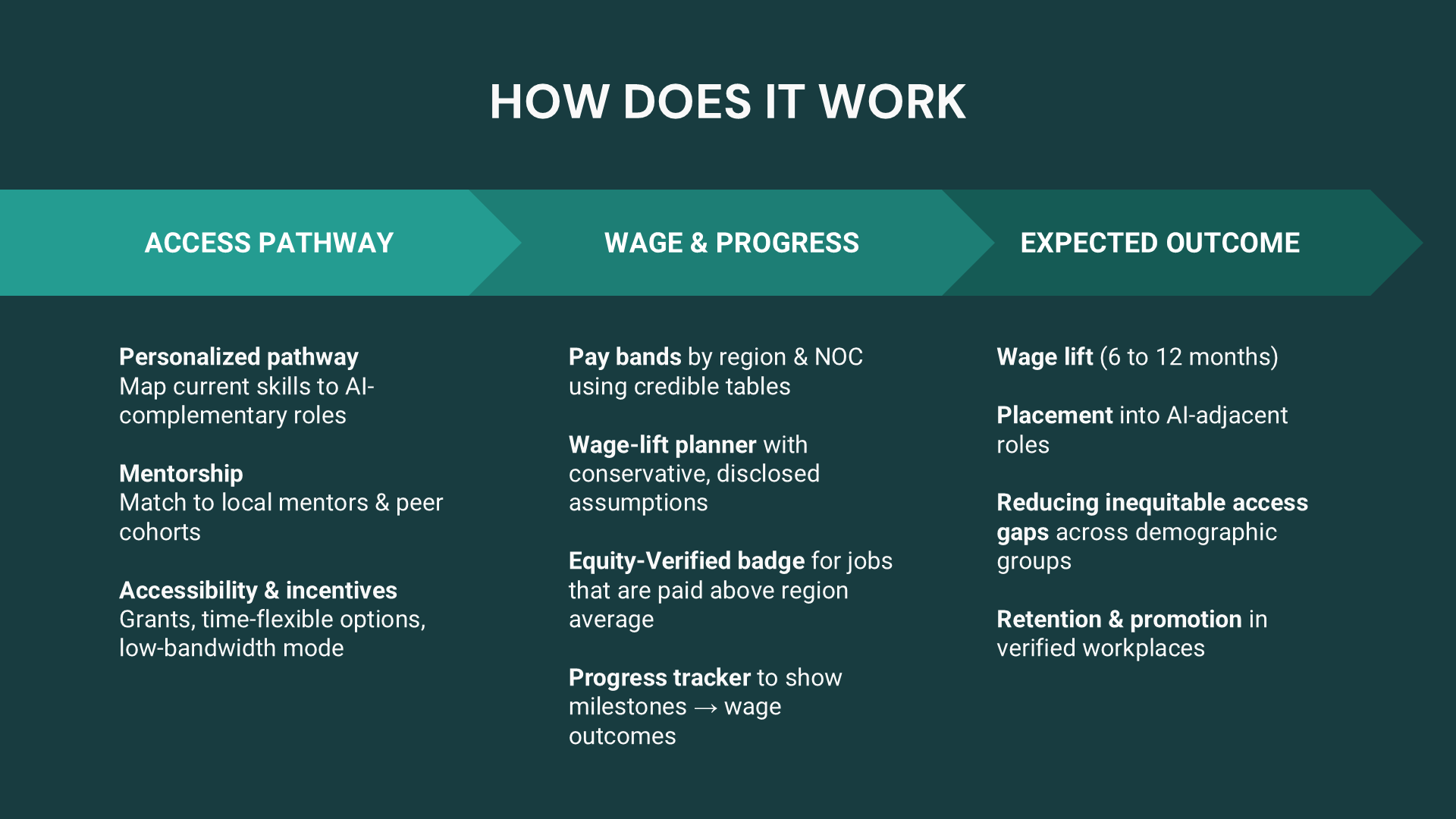
AI Bridge begins with transferable skills, experience, constraints, and goals. It then shows several AI-complementary roles instead of collapsing the decision into one opaque recommendation.
Treat pay as a planning signal
Regional wage bands sit beside the learning steps, time, and credentials required. That makes the trade-off visible while keeping every projected figure clearly separate from a guaranteed outcome.
Build support into the path
Mentorship, flexible learning, micro-credentials, and employer-equity signals are part of the proposed pathway—not extra content someone has to find after receiving a job match.
System
- Worker inputs
- Transferable skills, experience, access needs, location, and the kind of mobility a person is seeking.
- Market signals
- Open labour data connects adjacent roles with regional wage bands, training options, and local demand.
- Pathway logic
- Skill gaps become a sequence of learning steps, credentials, timing, and an explainable next action.
- Access supports
- Mentors, flexible formats, micro-credentials, and proposed employer-equity signals help make the route usable.
Outcome
Team bob finished first out of 86 teams.
AI Bridge was named the challenge’s first-place project on November 18, 2025. The published prize was CAD 2,000 per member—CAD 8,000 across the four-person team. The award recognizes the concept and its presentation; it does not demonstrate employment or wage impact. AI Bridge remains a competition prototype, not a live placement service.
Process
We began with the evidence, not the interface.
The team worked in three passes: understand where AI adoption was widening barriers, turn that research into an explainable worker journey, then shape the final pitch around one question—what should this person be able to do next, and why? The Tina scenario made the idea tangible while keeping its wage and timing figures clearly illustrative.
Selected views
Credits & links
AI Bridge was created by Team bob—Winnie Xie, I Putu Pramana Putra, Agin Joshi, and Rahul Paul—for the TECHNATION Canada 2025 AI Equity Data Challenge.
Collaborators
- Winnie Xie
- Agin Joshi
- Rahul Paul